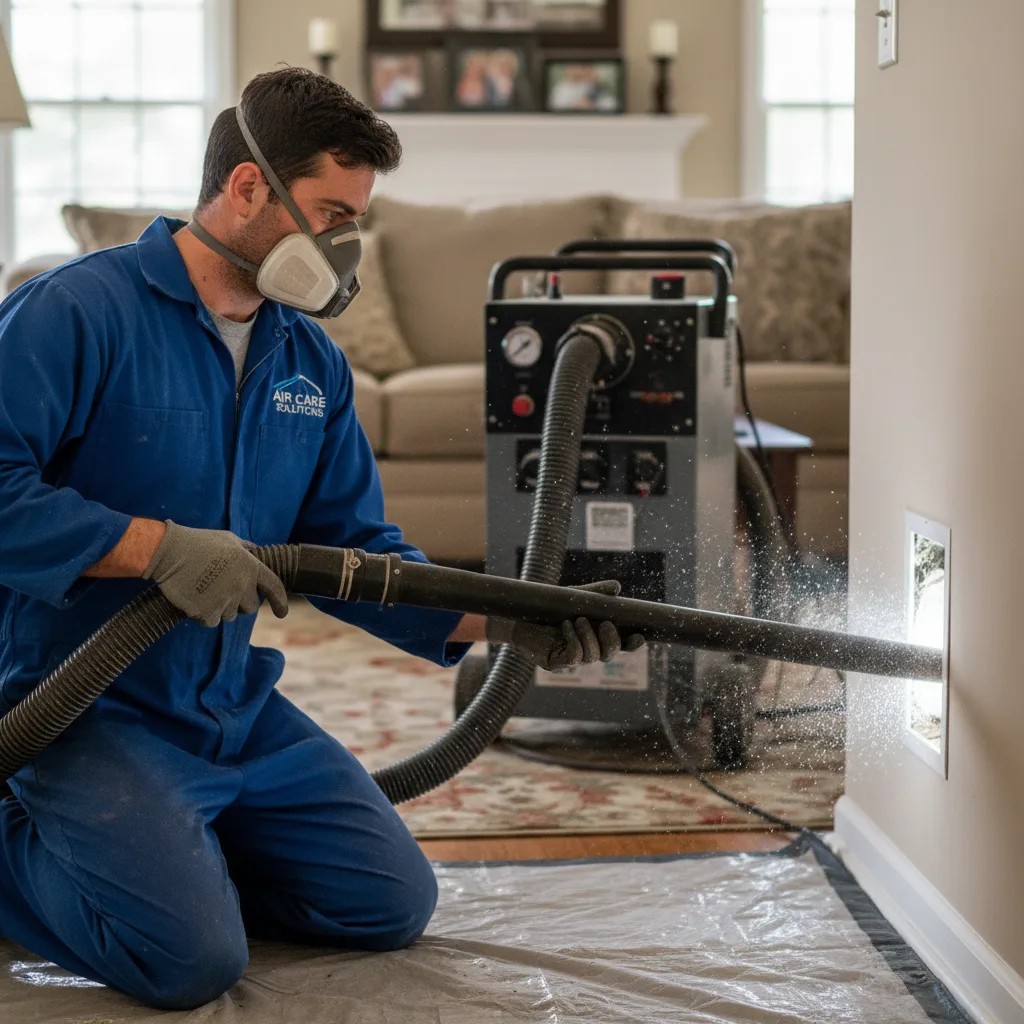
Air duct cleaning takes 2–5 hours for most residential homes. A small home (under 1,500 sq ft) typically takes 2–3 hours, while a larger home (2,500+ sq ft) with multiple HVAC systems can take 4–6 hours. Jobs that finish in under 90 minutes are likely incomplete — thorough cleaning requires accessing every supply and return run.
Average Time by Home Size
| Home Size | Square Footage | Typical Vents | Expected Duration |
|---|---|---|---|
| Small | 1,000–1,500 sq ft | 8–12 vents | 2–3 hours |
| Medium | 1,500–2,500 sq ft | 12–18 vents | 3–4 hours |
| Large | 2,500–3,500 sq ft | 18–26 vents | 4–5 hours |
| Very Large | 3,500+ sq ft | 26+ vents | 5–7 hours |
These estimates assume a two-person crew using truck-mounted negative pressure equipment and cleaning all supply and return vents plus the main trunk line. Single-technician crews or portable equipment jobs run longer, though they may not be as thorough.
Count your vents before calling: Walk through your home and count every supply register (where air blows out) and return grille (where air gets pulled in). This lets you verify a quote is accurate and gives you a realistic time estimate. Most homes have 1–2 returns and 1 supply per room.
What Actually Happens During the Cleaning
A professional air duct cleaning follows a specific sequence. Understanding the process helps you know what to expect and spot shortcuts.
Step 1: Setup and Negative Pressure (20–30 min)
The crew connects a large-diameter hose from their truck-mounted vacuum to your main return duct or air handler. This creates negative pressure throughout the duct system — meaning air is being continuously pulled toward the vacuum. This is critical. Without negative pressure, loosened debris just recirculates into your home instead of being extracted.
Step 2: Agitation at Each Vent (3–8 min per vent)
Working systematically through every supply and return vent, the technician removes the grille cover and inserts rotating brushes or compressed air tools to dislodge debris. The negative pressure system pulls everything dislodged toward the main collection point. This is the most time-consuming part — and where shortcuts are easiest to take. A rushed technician might spend 60 seconds at each vent instead of 5 minutes.
Step 3: Main Trunk Line (15–30 min)
The main trunk — the large central duct that branches out to individual rooms — gets its own thorough cleaning. Technicians access it through the air handler or a specially cut access panel, then use long-reach brushes to clean the full length. In larger homes with complex duct layouts, this step alone can take 30 minutes.
Step 4: Air Handler and Blower (15–20 min)
A thorough job includes inspecting and cleaning the blower motor, evaporator coil (if accessible), and air handler cabinet. This step often reveals the most significant buildup — especially in homes that haven't had maintenance in years. Skipping this step is a red flag.
Step 5: Reassembly and Final Check (15–20 min)
All vent covers go back on, the vacuum hose is disconnected and sealed, and the technician does a final walkthrough to confirm all vents are open and the system is operational. Some companies test airflow at multiple vents before leaving.
What Takes Longest
Number and Location of Vents
More vents means more time — straightforwardly. But location matters too. Second-floor vents, vents in closets, or vents behind large pieces of furniture all add time. Some vents require moving furniture or accessing tight crawl spaces.
Duct Material and Condition
Rigid metal ductwork is faster to clean than flexible duct. Flex duct's corrugated interior catches debris in its ridges and requires more agitation passes. Old or damaged flex duct can't handle aggressive brushing, which slows the process further.
Years Since Last Cleaning (or Never)
Heavy buildup requires more passes and more time per vent. A home that has never been cleaned or hasn't been cleaned in 10+ years will take significantly longer than one that was serviced 3 years ago.
Add-On Services
Dryer vent cleaning (add 30–45 minutes), coil cleaning (add 30–60 minutes), antimicrobial treatment (add 20–30 minutes drying time), and video inspection (add 30 minutes) all extend the job. Ask what's included in your quote and budget time accordingly.
Red Flags: When a Job Is Too Fast
If a crew finishes your 3-bedroom home in under 90 minutes, something was skipped. Common shortcuts: using a shop vac instead of truck-mounted equipment (faster but far less effective), only cleaning the visible 6 inches of each vent, skipping the main trunk line, or not cleaning the air handler at all.
Here's how to spot a rushed job:
- Single tech with no visible truck outside — legitimate crews use truck-mounted vacuums. If there's no large white service van parked outside with a hose running into your house, they're using portable equipment
- Finished in under 2 hours for any home over 1,500 sq ft — mathematically impossible to do properly
- Didn't remove vent covers — any legitimate cleaning requires removing and reinstalling each grille
- No mention of the air handler or blower — if they don't discuss these components, they likely skipped them
- No access panel or only used existing access points — thorough trunk cleaning often requires creating a new access panel
Questions to Ask Before Booking
These four questions help you set proper expectations and screen for quality:
- "How many technicians will you send?" Two-person crews are significantly more efficient and thorough than single techs.
- "Is truck-mounted equipment included?" If they hesitate or say "we use a high-powered portable unit," that's a yellow flag.
- "Do you clean the air handler and blower?" Yes = good. "We can for an extra charge" = check the price. "We don't do that" = find someone else.
- "How long do you estimate for my home?" If they quote under 2 hours for a 2,000 sq ft home without asking how many vents you have, they're not doing a thorough job.
What to Do While the Crew Is Working
You don't need to hover, but you should be home for the full duration. A few things to have ready:
- Clear access to all vents — move furniture away from floor registers before they arrive
- Secure pets in a room away from the work area (the equipment is loud)
- Have your thermostat accessible — they'll need to run the blower at various points
- If you have small children, keep them out of work areas during the job
After the job is complete, run your HVAC on "fan only" for 20–30 minutes with fresh filters installed. This circulates any residual fine particles through the new filters before you settle in for the evening.
Are You an HVAC Contractor?
GoHighLevel is the CRM platform built for home service businesses. Automate follow-ups, manage job schedules, and grow your revenue without the admin overhead.
Try GoHighLevel Free for 14 Days →Get Free Quotes from Vetted Local Contractors
We'll match you with 2–3 licensed air duct cleaning pros in your area.