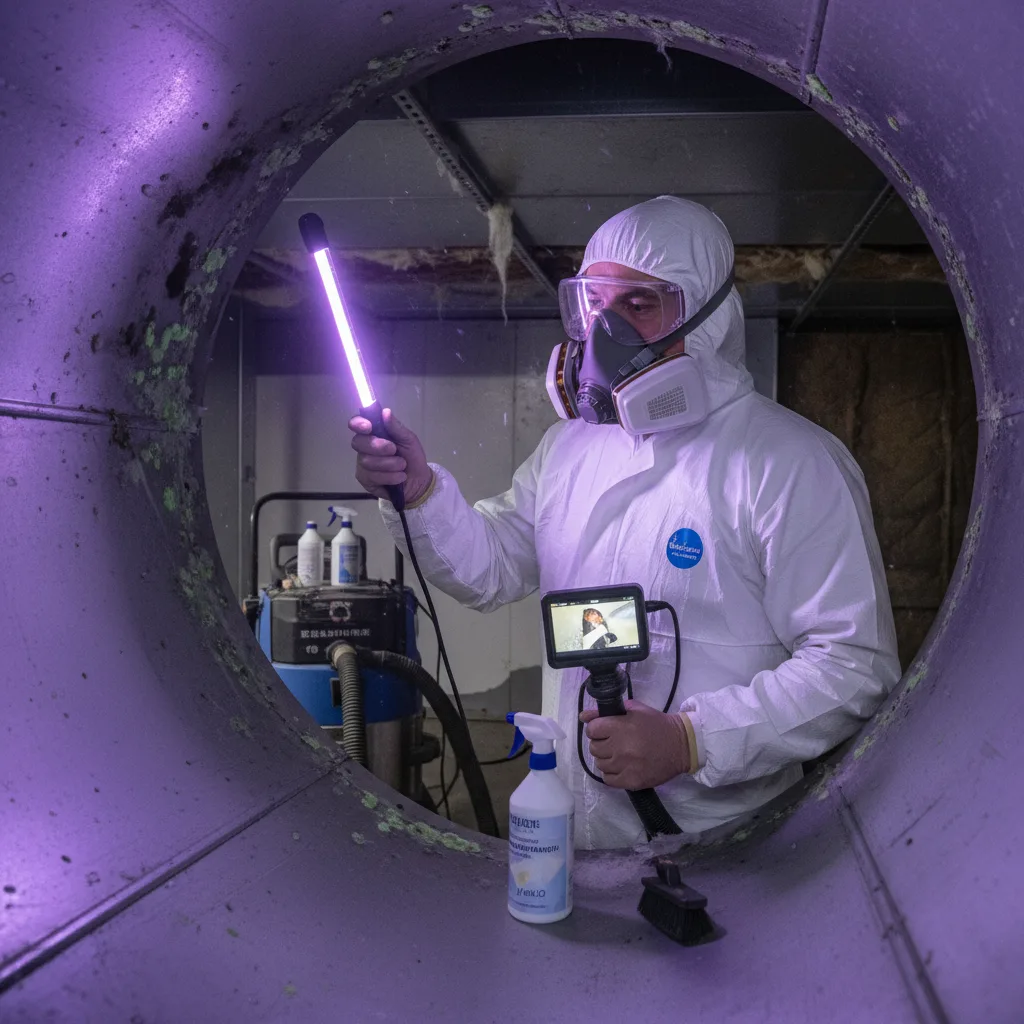
Of all the air duct problems homeowners face, mold is the most serious. Unlike dust or debris — which reduce air quality gradually — mold actively reproduces and distributes spores throughout your home every time the HVAC system runs. A small mold colony on your evaporator coil can seed mold growth throughout your living spaces within weeks.
The good news: HVAC mold is identifiable, treatable, and — most importantly — preventable with the right approach. Here's everything you need to know.
Why Mold Grows in Air Ducts
Mold needs three things to grow: organic material (food), warmth, and moisture. Your HVAC system provides all three:
- Food: Dust accumulation inside ducts contains organic material — skin cells, fabric fibers, pet dander — that feeds mold colonies
- Warmth: Ductwork running through conditioned spaces stays in the temperature range mold thrives in
- Moisture: This is the critical factor. Moisture enters the system through condensation on cold evaporator coils, humid air from poorly sealed duct connections, leaks near supply registers in humid climates, and flooding or water intrusion events
The evaporator coil is ground zero. The A/C evaporator coil runs cold during cooling cycles, causing condensation to form on its surface. This condensate is supposed to drain away through the drain pan and condensate line — but if the drain pan overflows, the condensate line clogs, or humidity is excessive, moisture spreads into the air handler and ducts. This is how most HVAC mold problems start.
How to Identify Mold in Your Air Ducts
Signs You Can Detect Yourself
- Musty or earthy odor when the HVAC runs — the most reliable indicator. The smell is strongest at supply vents. If your house smells musty only when the air turns on, mold in the ductwork is the likely culprit.
- Musty smell that gets worse in summer — increased A/C use means more condensation and higher mold activity seasonally
- Visible dark spots around supply vents — black or dark green discoloration around vent grilles can indicate mold spores being distributed from the system
- Worsening allergy or asthma symptoms when HVAC runs — mold spore exposure triggers respiratory symptoms that correlate with system operation
- Visible mold on vent covers — if mold is growing on the visible grilles, it's almost certainly present inside the ducts
What Professional Inspection Finds
A professional inspection with a flexible camera can see what you can't:
- Fuzzy or discolored growth on duct surfaces (true mold vs. dark dust staining)
- Mold on the evaporator coil, drain pan, or air handler components
- Water damage or staining indicating past moisture events
- Mold in flex duct insulation (the interior lining of flexible ducts is a prime mold habitat)
Testing Options
Visual inspection can identify obvious mold, but lab testing confirms the species and concentration:
- Air sampling ($150–$400): Captures airborne spore count. High counts suggest active mold somewhere in the system.
- Surface sampling ($100–$300): A swab from duct surfaces sent to a lab identifies mold species and confirms active growth vs. dead spores.
- DIY test kits ($10–$50): Available at hardware stores. Can detect mold presence but don't identify species or severity. Use as a preliminary screen, not a definitive answer.
🚨 Don't let the cleaning company do the testing. A company that profits from remediation should not be the one deciding whether remediation is needed. Get independent testing from a certified industrial hygienist or air quality professional before agreeing to any mold treatment. Learn more about duct cleaning scams →
Types of Mold Found in HVAC Systems
| Mold Type | Color | Common Location | Health Risk |
|---|---|---|---|
| Cladosporium | Black/green/brown | Duct surfaces, coils | Moderate — allergies, asthma trigger |
| Penicillium | Blue/green | Duct insulation, filters | Moderate — respiratory irritant |
| Aspergillus | Various | Drain pans, coils | Moderate to high — serious for immunocompromised |
| Stachybotrys (black mold) | Black/slimy | Requires sustained moisture | High — toxigenic, requires professional remediation |
| Alternaria | Brown/olive | Near condensation points | Moderate — common allergen |
Note that the colloquial term "black mold" specifically refers to Stachybotrys chartarum, which requires extremely wet conditions (prolonged flooding or persistent leaks) to establish. Most duct mold is less severe species like Cladosporium or Aspergillus — still requiring treatment, but not the immediate emergency that Stachybotrys represents.
Mold Remediation: What the Process Involves
Legitimate mold remediation in HVAC systems is more involved than a standard duct cleaning. Here's what a proper remediation looks like:
Step 1: Source Identification and Moisture Control
Before cleaning anything, the moisture source must be found and fixed. Cleaning mold without addressing the moisture is a temporary fix — mold will return within weeks. A thorough remediation company will assess the drain pan, condensate line, duct sealing, and any history of water intrusion before starting cleaning work.
Step 2: Containment
The work area should be isolated to prevent spore dispersal to the rest of the home during cleaning. This typically involves sealing supply registers and using negative pressure equipment that exhausts to the outside.
Step 3: Physical Removal
Mold must be physically removed — it cannot be killed and left in place. Dead mold is still allergenic. This means scrubbing affected surfaces, removing and replacing heavily contaminated flex duct sections, and cleaning all HVAC components where mold is present.
Step 4: HEPA Vacuuming
After physical removal, HEPA vacuuming captures loose spores throughout the system.
Step 5: Antimicrobial Treatment (Where Appropriate)
EPA-registered antimicrobial coatings can be applied to duct surfaces after cleaning to inhibit future mold growth. This is appropriate where mold remediation has occurred, not as a substitute for cleaning. Note: the EPA does not recommend antimicrobial sprays as a routine preventive measure in clean systems.
Step 6: Post-Remediation Verification
A clearance test — typically air sampling or surface sampling by an independent party — should confirm that mold levels have returned to acceptable levels before the remediation is considered complete.
How Much Does Duct Mold Remediation Cost?
Mold remediation costs significantly more than standard duct cleaning due to the additional procedures involved:
| Scope | Typical Cost |
|---|---|
| Mold cleaning (limited — evaporator coil area) | $500–$1,200 |
| Full duct cleaning + antimicrobial treatment | $800–$2,000 |
| Extensive remediation (flex duct replacement + full system) | $2,000–$6,000 |
| Independent air quality testing (before + after) | $300–$800 |
| HVAC drain system repair (condensate line, drain pan) | $150–$600 |
Use our cost calculator for a base estimate, but be aware that mold remediation quotes are highly specific to each situation. Get at least 3 quotes from NADCA-certified companies with specific mold remediation experience. For local pricing: Dallas and other Southern cities tend to run higher due to higher humidity and more frequent mold issues.
Preventing Mold in Your Air Ducts
Prevention is far cheaper than remediation. These measures address the root causes:
Control Indoor Humidity
Keep indoor relative humidity between 30–50%. Above 60%, mold growth accelerates dramatically. Use a whole-house dehumidifier in humid climates (especially in Southern states), run bath and kitchen exhaust fans diligently, and ensure your HVAC system is properly sized — an oversized system that short-cycles doesn't run long enough to dehumidify effectively.
Maintain Your Condensate System
The evaporator drain pan and condensate line should be inspected annually. Pour a cup of diluted bleach into the drain pan access point once or twice per cooling season to prevent algae and mold buildup in the drain line. A clogged condensate line is one of the most common causes of HVAC water damage and mold.
Replace Filters on Schedule
A clogged filter restricts airflow, which causes the evaporator coil to ice up during cooling. When the ice melts, it overwhelms the drain pan — spreading moisture to the air handler and ducts. Change your filter every 60–90 days (more often with pets or in dusty environments).
Annual Evaporator Coil Inspection
Include evaporator coil cleaning in your annual HVAC maintenance. A dirty coil causes more condensation and provides organic material for mold. See our full HVAC maintenance checklist →
Seal Duct Leaks
Leaky ducts in unconditioned spaces (attics, crawl spaces) draw in humid outdoor air. Sealing duct leaks with mastic sealant or metal-backed tape reduces moisture infiltration and improves system efficiency.
Concerned About Mold in Your Ducts?
Get quotes from certified mold remediation specialists in your area.
🏢 Are You a Duct Cleaning or Mold Remediation Contractor?
Mold remediation jobs are high-value and referral-driven. GoHighLevel helps you automate follow-ups, collect 5-star reviews, and build the referral network that brings consistent work.
GoHighLevel for HVAC Businesses → Professional Quoting Software →