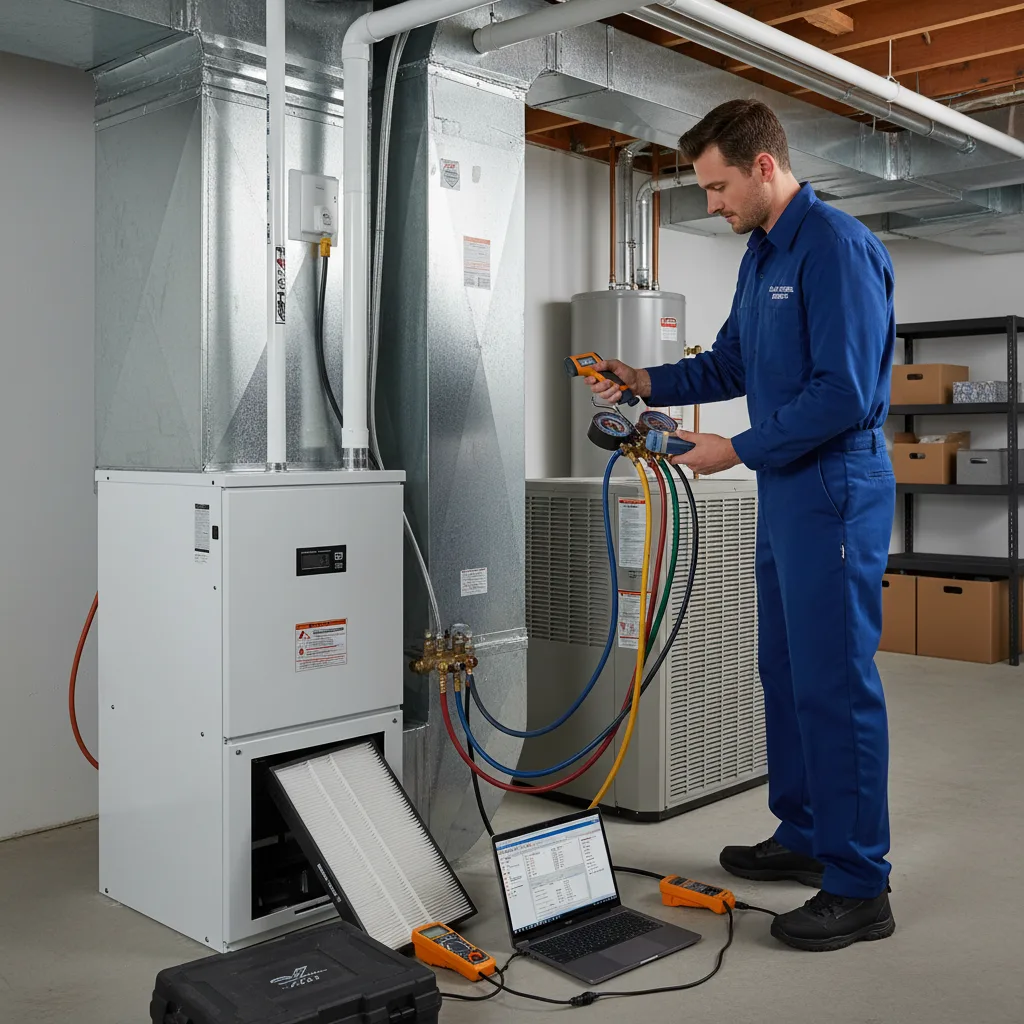
Your HVAC system is the hardest-working appliance in your home. It runs year-round — heating in winter, cooling in summer — and most homeowners never give it a second thought until something breaks. That neglect costs money: a poorly maintained system uses 15–25% more energy than a well-maintained one, and deferred maintenance is responsible for the majority of HVAC failures.
The good news: staying on top of HVAC maintenance doesn't require much time or expertise. Most tasks are simple DIY work. The key is knowing what needs to be done, how often, and what to leave to professionals.
The Master HVAC Maintenance Calendar
| Task | Frequency | DIY or Pro? |
|---|---|---|
| Change air filter | Every 1–3 months | DIY |
| Check/clean condensate drain line | Every 3 months | DIY |
| Inspect/clean outdoor condenser unit | Spring & Fall | DIY |
| Test heating system before winter | Every fall | DIY |
| Test cooling system before summer | Every spring | DIY |
| Professional tune-up (cooling) | Annually (spring) | Pro |
| Professional tune-up (heating) | Annually (fall) | Pro |
| Inspect/clean supply and return vents | Every 6 months | DIY |
| Professional air duct inspection | Every 3–5 years | Pro |
| Professional air duct cleaning | Every 3–7 years | Pro |
| Dryer vent cleaning | Annually | DIY or Pro |
| Check refrigerant levels | Annually | Pro only |
| Inspect ductwork for leaks | Every 3–5 years | Pro |
| Clean evaporator and condenser coils | Every 1–2 years | Pro |
Monthly Tasks: Filter Changes
Air filter replacement is the single most impactful thing you can do for your HVAC system. A clogged filter forces the blower to work harder, reduces airflow, drops efficiency, and can cause the system to freeze up (in cooling mode) or overheat (in heating mode). It also dramatically worsens indoor air quality.
Filter Change Schedule by Household Type
- Single person, no pets: Every 60–90 days
- Couple or small family, no pets: Every 60 days
- Family with pets: Every 30–45 days
- Multiple pets or allergy sufferers: Every 20–30 days
- Vacation home or rarely occupied: Every 6–12 months
Choosing the Right Filter
MERV (Minimum Efficiency Reporting Value) ratings tell you how effectively a filter captures particles:
- MERV 4–7: Basic fiberglass filters. Cheap, low efficiency. Protects equipment but does little for air quality.
- MERV 8–10: Standard pleated filters. Good balance of efficiency and airflow. Good for most homes.
- MERV 11–13: High-efficiency pleated filters. Best for allergy sufferers and pet owners. Check your system specs — not all units handle this.
- MERV 14+: HEPA-grade. Rarely suitable for residential HVAC — too restrictive for most residential blowers. Use standalone HEPA purifiers instead.
Pro tip: Don't assume the most expensive filter is best for your system. Check your owner's manual for the maximum recommended MERV rating. Installing a filter that's too restrictive reduces airflow and can cause ice buildup on the evaporator coil — the opposite of what you want.
Seasonal Checklist: Spring (Pre-Cooling Season)
Spring is the most critical maintenance window because your cooling system is about to work hardest all year. Address these items in March–April before temperatures climb:
DIY Tasks — Spring
- Replace the air filter with a fresh filter before the cooling season starts
- Clear the outdoor condenser unit. Remove winter covers, debris, leaves, and overgrown vegetation. The condenser needs 18–24 inches of clearance on all sides for adequate airflow
- Clean condenser fins. Gently rinse the exterior of the condenser coil with a garden hose from the inside out to remove dust, pollen, and debris. Bent fins can be carefully straightened with a fin comb
- Flush the condensate drain line. Pour a cup of white vinegar or a condensate drain tablet into the drain pan. This prevents algae and mold buildup that causes drain clogs and overflow
- Test the system. Run the A/C for 15 minutes and confirm it cools properly and all vents are delivering airflow
- Inspect supply and return vents. Vacuum visible dust from all vent grilles. Make sure furniture or rugs aren't blocking vents
- Check duct registers. Inspect accessible duct segments in the attic or basement for visible damage, disconnections, or rodent entry points
Professional Tasks — Spring
Schedule a professional A/C tune-up in early spring (March–April) before HVAC companies get swamped. A thorough tune-up includes:
- Refrigerant level check and recharge if needed (pro-only — refrigerant handling requires EPA 608 certification)
- Evaporator and condenser coil cleaning
- Electrical component inspection (capacitors, contactors, wiring)
- Blower motor inspection and lubrication
- Thermostat calibration
- Ductwork inspection for leaks and damage
Expect to pay $80–$150 for a standard tune-up. Annual maintenance contracts ($150–$300/year for both heating and cooling tune-ups) often include priority service and discounts on repairs.
Seasonal Checklist: Fall (Pre-Heating Season)
Before temperatures drop, switch focus from cooling to heating maintenance:
DIY Tasks — Fall
- Replace the air filter again before the heating season
- Test the heating system. Turn on the heat on the first cool day and let it run for 30 minutes. Verify all zones heat properly and watch for unusual smells (burning dust on a newly activated furnace is normal for the first run of the season; persistent burning smell is not)
- Check/replace thermostat batteries if applicable
- Inspect the gas furnace flame. Should be steady blue. Yellow or orange flames indicate combustion issues — call a professional immediately
- Clear the area around the furnace. Keep at least 3 feet of clearance around all sides. Remove stored items that accumulated over summer
- Check the flue/exhaust pipe for blockages, especially bird nests over the summer
- Cover or protect the outdoor condenser unit (only if you're in a climate with heavy snow/ice; do NOT seal it completely — moisture must be able to escape)
Professional Tasks — Fall
Schedule a furnace tune-up in September or early October before the heating rush. This should include:
- Heat exchanger inspection for cracks (cracked heat exchangers leak carbon monoxide — a serious safety hazard)
- Burner cleaning and adjustment
- Igniter and flame sensor testing
- Flue gas analysis to verify safe combustion
- Carbon monoxide detector testing
- Blower belt inspection (on older belt-drive systems)
🚨 Carbon monoxide safety: A cracked heat exchanger is a life-threatening emergency. If your CO detector goes off or your furnace technician finds a cracked heat exchanger, do not operate the system. This is not a deferred maintenance item. Install CO detectors near bedrooms if you don't already have them.
Duct Inspection and Cleaning Schedule
Your duct system deserves dedicated attention beyond just changing filters. Here's how to approach it:
Annual DIY Duct Inspection
Once a year, do a basic visual check:
- Remove supply vent grilles and look inside with a flashlight — visible dust buildup, debris, or discoloration is normal; mold or water staining is not
- Check return vent covers — return vents accumulate more dust and are a good indicator of overall system cleanliness
- Inspect accessible ductwork in attics, crawlspaces, and basements for physical damage, disconnected sections, or pest entry points
- Look for duct insulation damage that could cause condensation and mold issues
Professional Duct Cleaning Frequency
The EPA recommends duct cleaning only when there's a specific reason, but industry guidelines suggest:
- Standard households: Every 5–7 years
- Homes with pets or allergy sufferers: Every 3–5 years
- After any major renovation: Immediately — see our post-renovation cleaning guide
- Moving into a new home: Consider cleaning before move-in — see our guide for new homeowners
- After flood, fire, or mold remediation: Immediately
Always choose a NADCA-certified company for professional duct cleaning. Use our cost calculator to estimate pricing for your home.
Energy Savings: What Good Maintenance Is Worth
HVAC maintenance isn't just about preventing breakdowns — it directly impacts your energy bills:
| Maintenance Action | Estimated Energy Savings | Annual Dollar Savings* |
|---|---|---|
| Regular filter changes (vs. clogged) | 5–15% | $50–$150 |
| Clean evaporator/condenser coils | 10–15% | $100–$150 |
| Seal duct leaks | 10–30% | $100–$300 |
| Annual professional tune-up | 5–10% | $50–$100 |
| Programmable thermostat use | 10–15% | $100–$150 |
*Based on average annual HVAC energy cost of $1,000 for a typical US home.
The ROI on Maintenance
A typical HVAC maintenance program costs $200–$400 per year (professional tune-ups + filters). Energy savings of 15–25% on a $1,000 annual HVAC bill means $150–$250 in direct savings — plus avoided repair costs that average $300–$500 per incident. Well-maintained systems also last 15–20 years vs. 10–12 years for neglected systems, saving $3,000–$5,000 on premature replacement.
Checklist for Homeowners: Signs You Need a Pro Now
Some issues need immediate professional attention, not deferred maintenance:
- 🔴 CO detector goes off or you smell gas
- 🔴 Burning smell that persists beyond first heating cycle of the season
- 🔴 Yellow or orange furnace flame
- 🔴 System trips circuit breaker repeatedly
- 🔴 Ice forming on indoor unit or refrigerant lines
- 🟡 System running but not reaching set temperature
- 🟡 Unusual noises (banging, squealing, grinding)
- 🟡 Significant increase in energy bills without explanation
- 🟡 Visible mold near vents or musty smell when system runs (see our mold guide)
- 🟡 Water pooling around the indoor unit
Finding Qualified HVAC Contractors
For professional maintenance and repairs, look for:
- NATE certification (North American Technician Excellence) — the industry's primary technical credential for HVAC technicians
- EPA 608 certification — required by law for technicians who handle refrigerants
- State contractor license — required in most states for HVAC work
- Liability insurance and worker's comp — protect yourself from liability if a technician is injured on your property
We have vetted contractor guides for Dallas, Phoenix, Houston, Atlanta, Denver, and other major cities. Avoid scam operators who offer suspiciously low prices for "full system" service.
Schedule Your HVAC Tune-Up
Connect with certified HVAC professionals for seasonal maintenance in your area.
Printable Quick-Reference Checklist
Every month: Check filter — replace if visibly loaded or overdue.
Every spring: Change filter, clean condenser, flush condensate drain, run A/C test, schedule pro tune-up.
Every fall: Change filter, test heat, inspect furnace flame, schedule pro furnace inspection.
Every year: Clean dryer vent, inspect duct vents, check thermostat batteries.
Every 3–5 years: Professional duct inspection, consider duct cleaning if warranted.
After any renovation, flood, or major event: Professional post-event duct cleaning.
🏢 HVAC Contractors: Automate Your Maintenance Reminders
Seasonal maintenance reminders are your best source of repeat business. GoHighLevel lets you automate filter change reminders, tune-up scheduling, and annual maintenance follow-ups across your entire customer base.
GoHighLevel for HVAC Businesses → Professional Quoting Software →