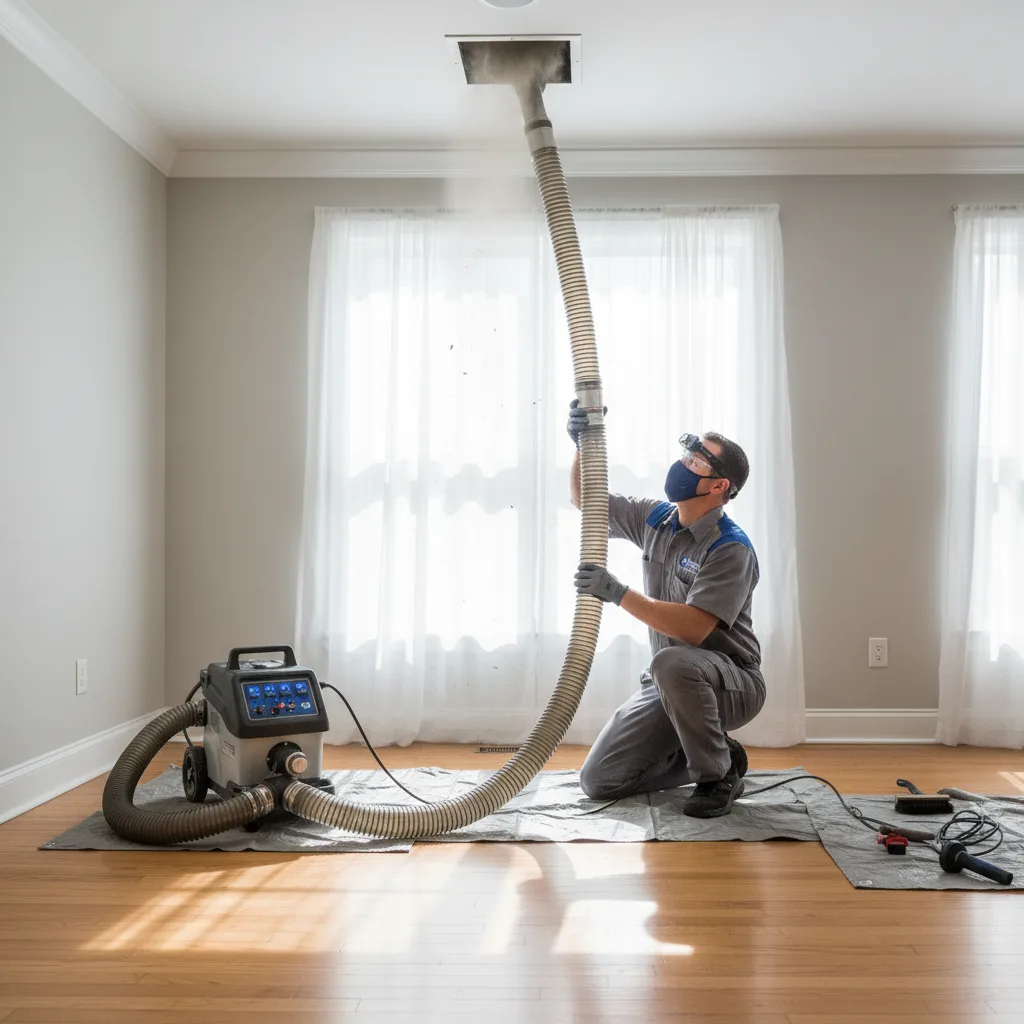
Smoke damage in air ducts costs $500-$1,500 to clean professionally. The process requires negative air pressure, chemical deodorizing agents, and in severe cases, duct insulation replacement. Smoke particles penetrate deep into ductwork and cannot be fully removed with standard equipment — persistent odor after cleaning usually means the insulation inside the ducts has absorbed the smoke compounds.
There are three common smoke scenarios homeowners deal with, and each one requires a different approach.
Scenario 1: Cigarette Smoke in the Home
This is the most common scenario, especially when buying a home from a previous owner who smoked indoors. Years of cigarette smoke deposits a layer of tar and nicotine residue on every interior surface, including the inside of air ducts. The residue is yellowish-brown, sticky, and carries the distinctive stale tobacco smell.
What Happens in the Ducts
Cigarette smoke particles are extremely fine, typically 0.1 to 1 micron in size. Standard HVAC filters (MERV 8 or lower) capture very few of these particles. The rest pass through and deposit on duct walls, the evaporator coil, the blower housing, and inside every supply register. Over years of smoking, this creates a measurable buildup that continuously off-gasses back into the air.
Signs It Is Needed
- Persistent tobacco odor, especially when the HVAC system runs
- Yellowish or brownish residue visible on register covers
- Odor returns after cleaning walls and surfaces
- New occupants notice the smell even after deep cleaning the home
What Cleaning Involves
Standard duct cleaning is a start but often not enough for heavy cigarette smoke. A proper job for smoke-contaminated ducts includes mechanical cleaning of all duct surfaces, cleaning the evaporator coil and blower assembly, and an antimicrobial or deodorizing treatment applied inside the ductwork. Some contractors use ozone treatment or thermal fogging as a follow-up step.
Typical cost: $400 to $700 for an average home, more if the evaporator coil and blower need separate cleaning.
Buying a home from a smoker? Request duct cleaning as a closing concession. Budget $400 to $700 and schedule it before you move in. Also have the evaporator coil cleaned, which may add $100 to $200. Replace all filters immediately. If you skip any of these, the smell will keep coming back because the HVAC system pushes it into every room.
Scenario 2: Wildfire Smoke Events
Wildfire smoke is increasingly common, especially in the western United States. During a wildfire event, outdoor air quality plummets and fine particulate matter (PM2.5) infiltrates homes through every gap, including the HVAC system. Even with windows closed, wildfire smoke gets in.
What Happens in the Ducts
Wildfire smoke contains a complex mix of fine carbon particles, volatile organic compounds (VOCs), and ash. These particles are even finer than cigarette smoke and pass through most residential filters. During extended wildfire events lasting days or weeks, a significant amount of this particulate settles inside the duct system.
When Cleaning Is Worth It
If the Air Quality Index (AQI) in your area exceeded 200 for multiple days and you could smell smoke inside your home, duct cleaning is a reasonable step. This is especially true for households with children, elderly occupants, or anyone with asthma or respiratory conditions.
If you ran your HVAC system during the event (which most people do for air circulation), the ducts collected more particulate than if the system was off. Check your filter. If it turned noticeably darker during the event, debris got into the system beyond the filter.
Typical cost: $350 to $600, which is similar to standard duct cleaning because wildfire residue is lighter than cigarette tar.
Scenario 3: House Fire or Structural Fire
Fire damage to a home is the most severe scenario and requires a completely different approach than routine cleaning.
What Happens in the Ducts
A structural fire produces heavy soot, toxic fumes from burning plastics and synthetics, and extreme heat. Soot particles are greasy and adhere aggressively to every surface. The heat can warp metal ductwork, melt flex duct, and destroy insulation. Even in areas of the home not directly burned, soot travels through the HVAC system and deposits throughout the entire duct network.
Cleaning vs Replacement
For minor fires (contained to one room, quickly extinguished), professional cleaning with soot removal treatment is often sufficient. The key is that the ductwork itself is structurally intact.
For significant fires, partial or full duct replacement is usually necessary. Flex duct that has been exposed to high heat is compromised even if it looks intact. Metal duct with heavy soot contamination may not clean thoroughly enough to eliminate the odor. A fire restoration specialist should assess the HVAC system before any cleaning is attempted.
| Fire Severity | Typical Duct Action | Estimated Cost |
|---|---|---|
| Small, contained fire (kitchen, one room) | Professional cleaning + deodorization | $500 to $1,000 |
| Moderate fire (multiple rooms affected) | Cleaning + partial replacement | $1,000 to $3,000 |
| Major structural fire | Full system replacement | $3,000 to $8,000+ |
Insurance note: Duct cleaning and replacement after a fire is typically covered under your homeowner's insurance policy as part of smoke damage remediation. Document everything with photos, keep all receipts, and make sure your restoration contractor itemizes the HVAC work separately on the estimate. Insurance adjusters are more likely to approve clearly documented line items.
What to Ask Contractors for Smoke Damage
Smoke-contaminated duct cleaning is more specialized than routine cleaning. Ask these questions before hiring:
- Do you have experience with smoke damage specifically, not just routine cleaning?
- What deodorization method do you use? (Thermal fogging, ozone, antimicrobial spray)
- Will you clean the evaporator coil and blower assembly as part of the job?
- Do you offer before and after air quality testing?
- For fire damage: are you IICRC certified for fire and smoke restoration?
- Do you guarantee odor elimination, or only reduction?
Be wary of companies that promise to eliminate all smoke odor with one round of standard duct cleaning. Heavy smoke damage often requires multiple treatments or a combination of cleaning, deodorization, and component replacement to fully resolve.
Get Smoke Damage Duct Cleaning Quotes
Connect with contractors experienced in smoke and fire damage. Free quotes, no obligation.
Are You a Restoration or HVAC Contractor?
Smoke damage duct cleaning is a high-value specialty service. Use GoHighLevel to automate follow-ups with insurance adjusters and homeowners during the claims process.
GoHighLevel for HVAC Businesses →